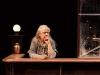
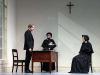
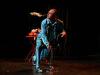
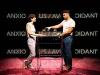
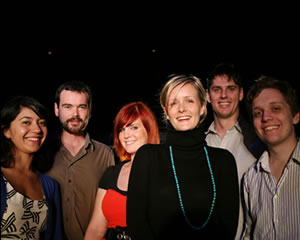
 Left - NIDA Graduating Directors
Having already reviewed the other half of NIDA’s wonderful graduating Directors’ programme Emergency, one feels spoiled for choice with these six fascinating productions. While the Space Programme featured perhaps the most enjoyable plays, this Studio Programme group was ultimately the more stimulating.
The evening begins with John Herbert’s Canadian classic Fortune and Men’s Eyes, a harrowing tale of men in prison and the appalling depredations of physical, emotional and especially sexual abuse they inflict upon each other, and the complex struggles of power, sexuality and politics that go hand-in-hand with survival. The 1967 play has lost little of its power over the ensuing forty years – although we may be more familiar with the concepts today, the confronting emotional impact of the piece remains intense.
Thus director Kate Revz’s decision to set the play in an ambiguously futuristic Orwellian milieu, complete with substituting the low-tech horror of conventional tortures for remote-activated brain implants, was a curious one. Apart from the issue of homosexuality itself being a gaoling offence, the play seems to contain little that tied it to any particular time period, thus making a realistic, contemporary route seem the more obvious choice. Not that the gleaming white, “prison by Steve Jobs” look detracted from the story – being a very well executed design, in fact – it merely seemed an unnecessary stylistic indulgence, even a potential distraction, a distancing effect from the reality of the story. However, one may forgive this as it is, after all, a Directors’ showcase, and those involved are keen to make a strong impression.
Quibbles over her design choices aside, Revz certainly has made an impression. Having marshalled a splendid cast to lay themselves bare in four striking performances, she has set the bar high in this group of directors for dramatic intensity. With a play of such high emotion and strong characterisation, it would be a slippery slope from which to tumble into awkward excess, but Revz modulates these extremes with considerable adeptness. Praise also to the wonderful actors: the intimidating Alex Russell as the cruel bully Rocky, rising star Guy Edmonds as the equally cruel and extremely camp Queenie, Matthew Backer in a powerfully vulnerable performance as Mona, all tied together by George Sheppard as the protagonist Smitty, who does an excellent job with his tragic character arc.
Next we were treated to another Tennessee Williams one-act play, This Property is Condemned, an unrelated, simplified production of which was presented a few months ago as part of Ensemble Theatre’s 50th Anniversary show. A far quieter, more contemplative piece than Williams’ And Tell Sad Stories of the Deaths of Queens in the Space Programme, it concerns a teenage boy having a strange, haunting conversation with Willie, a self-deluding girl wandering the train lines, left alone after her idolised sister died (who, if one reads between the lines, lived a life of virtual prostitution).
Ably directed by Imara Savage, this piece is one that is quietly intriguing, as it lacks action or much narrative, instead relying on revelation of character by inference, and the gradual leaking out of many unsettling undertones. Savage has done some fine work here, creating strong senses of mood, character and disquieting emptiness, boldly allowing an already leisurely text to really take the time to breathe.
Once again though, I had some issues with the design choices. The highly evocative set by Michael Hankin used a hay-strewn space littered with broken furniture and dominated by a tilted telegraph pole, yet for all this it failed to include the crucial railway tracks. Was this to suggest that Willie is so crazy that she imagined them? Similarly, the use of heavy white makeup, live violin (Olga Solar) and body mics to create occasional disquieting sonic effects all seemed to be selfconsciously playing the Southern Gothic angle to the hilt. Given the excellent performances by Katherine Moss and Gabriel Fancourt, I felt Savage somewhat undermined her own accomplished direction with these unnecessary flourishes.
The showcase ended on a high note with Paula Vogel’s Pulitzer Prize winning play How I Learned to Drive. Reflecting on the experiences and conflicted emotional journey of Li’l Bit and her long period of sexual molestation by her beloved uncle-by-marriage Peck, the play uses a fragmented, non-linear technique that hops around between the direct address of the adult woman and many vignettes from different points from her teenage years in the 1960s. Vogel’s approach is a perfect (albeit familiar) method of representing memory as a series of fragments rather than a continuous narrative, as well as an effective way of generating dramatic tension in a piece in which the crux of the plot must by necessity be revealed at the outset rather than built towards.
Directed economically by Mark Grentell, this is a great piece, and a prime example of how a short one act play can have more richness of content than “full-length” productions twice the its length. If the evening’s three plays could be said to have a shared thematic link (by accident or design), it would probably be an exploration of exploited sexuality and the myriad emotional issues surrounding it. This makes How I Learned to Drive an apt note to close on, being a piece that displays no clear answers but rather deep ambivalences and contradictions. Filled with moments at once humorous and distressing, this play has an overwhelming sense of humanity which Grentell has beautifully realised.
Although the complex set design is rather ugly and seems to add little (by far the least striking of the six plays), the production nevertheless does not fall prey to the elements of distracting gimmickry that niggled at one’s appreciation of the previous two, relying instead on Grentell’s spot-on direction of his talented group of actors. While everyone involved was excellent, there can be no doubt that leading lady Gabrielle Scawthorne as Li’l Bit was the lynchpin of the show, and it was a tremendous performance, especially given that one imagines the adult part is written for a somewhat older actress looking back over the gulf of decades. Scawthorne makes the role her own, however, and rounds off the evening on a moving, upsetting and yet unexpectedly affirming note.
As was the case with its companion trio, Emergency [Studio Programme] is an absorbing collection of excellent work by some very promising new talent. It will be a pleasure to watch these new directors mature over the course of their careers, as they clearly have much to offer the Australian theatre scene.
NIDA GRADUATING DIRECTORS
a.k.a. THEATRE FORWARD present
EMERGENCY
A season of six short plays
Venues: Parade Theatres, NIDA | 215 Anzac Parade, Kensington
Parade Studio and Parade Space
Season: 26 – 29 November 2008
Evenings: Wednesday 26, Thursday 27, Friday 28, Saturday 29 7.30pm
Matinee: Saturday 29 November 2pm
Prices: Adult $25 | Concession $15 | Groups 10+ $15
Bookings: 1300 795 012 or www.ticketek.com.au
Info: www.nida.edu.au
SPACE PROGRAM
And Tell Sad Stories of the Death of Queens by Tennessee Williams
Director: David Harmon
In the Solitude of Cotton Fields by Bernard Marie Koltès, trans. Jeffrey Wainwright
Director: Morgan Dowsett
The Bald Soprano by Eugène Ionesco
Director: Sarah Giles
STUDIO PROGRAM
Fortune and Men's Eyes by John Herbert
Director: Kate Revs
This Property is Condemned by Tennessee Williams
Director: Imara Savage
How I Learned to Drive by Paula Vogel
Director: Mark Grentell